
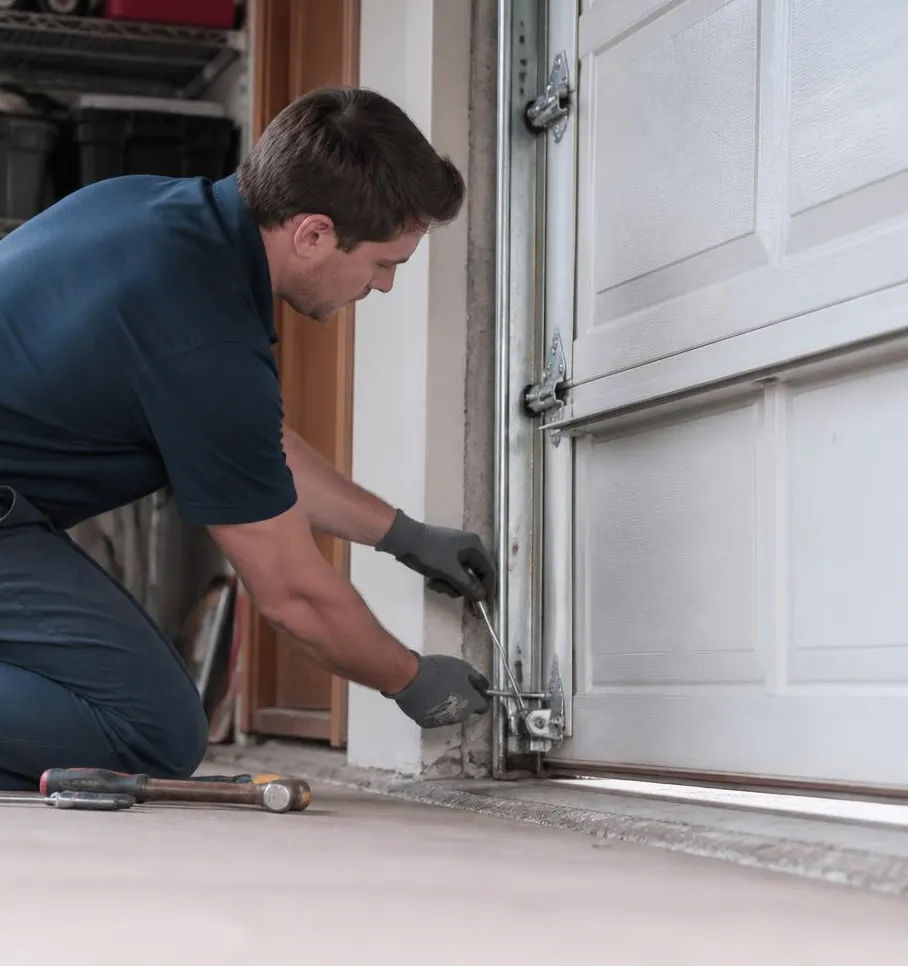
You're backing out for work and you hear it: a grinding, shuddering sound as the door comes down, like something's dragging that shouldn't be. Or maybe you notice the door isn't quite level anymore — one side drops a beat before the other. One of you says "it's fine, it's always done that." The other one isn't so sure. Here's how to settle it.
What That Grinding Sound Actually Is
Nine times out of ten, that noise is coming from the rollers — the small wheels that ride in the track on either side of the door. Rollers wear out the same way shoes wear out: slowly, until one day they're loud about it. Signs you're dealing with worn rollers include:
- A grinding or rattling sound that gets worse as the door moves, not just at the start
- Visible wobble or shake in the door panels as they travel
- Jerky, stop-start movement instead of a smooth glide
- Cracked or flat-spotted rollers you can see if you look closely at the track
Rollers don't fail all at once. They fail one at a time, which is why the door often looks crooked before it ever looks broken — one side is still gliding fine while the other is dragging on a worn wheel.
The Cable You Don't Want to Argue About
Cables are a different story, and a more serious one. These are the steel cables that run alongside the springs and take the weight of the door as it opens and closes. When they fray, you'll usually see it before you hear it: individual strands poking out like a frayed shoelace, usually near the bottom bracket or where the cable wraps around the drum at the top.
A frayed cable isn't a "get to it eventually" problem. These cables are under serious tension because of the springs they're paired with, and a cable that lets go while the door is in motion can cause the door to drop hard and fast, or cause the door to hang crooked and strain against the track. If you see frayed strands, treat the door as off-limits until it's inspected — don't run it through normal use hoping it holds.
Why Suwannee County Weather Makes This Worse
Heat and humidity speed up both problems. Steel rollers and cables that sit in a garage soaking up moisture from the air, especially during the long stretch of afternoon downpours and storm season, start to rust faster than they would somewhere drier. Rust on a cable isn't just cosmetic — it pits the steel and weakens individual strands from the inside, which is exactly what leads to fraying. Rust on roller bearings makes them seize or grind instead of spinning freely.
Humidity also swells wood and some composite door panels slightly, which throws off the alignment between the door and the track. A roller that's already borderline worn has to work harder to ride a track that's not sitting quite true, which shortens its life even more. If you're closer to the coast and get any salt air mixed in, that corrosion timeline moves up further.
What to Check This Weekend (Safely)
You can do a real inspection without touching anything dangerous:
- With the door closed, look at the rollers in the track — check for cracks, flat spots, or rust buildup
- Look at the cables near the bottom brackets and top drums for frayed strands or visible rust
- Watch the door move through a full cycle and note if one side lags, shakes, or drops faster than the other
- Listen for where the noise is loudest — front rollers, back rollers, or near the top where the cable winds
What you should not do is touch the cables, the drums, or the springs themselves. They're all connected under tension, and loosening the wrong bracket can release that tension suddenly.
Rollers vs. Cables: Different Fixes, Different Risks
Rollers are the more forgiving repair. Nylon rollers run quieter and hold up better in humid garages than older steel rollers without sealed bearings, and swapping a full set is a straightforward job — nationally, roller replacement tends to run in the lower hundreds of dollars depending on roller quality and how many need replacing.
Cables are a different category of repair. Because they're tied directly to spring tension, replacing a frayed cable means safely relieving that tension first. This isn't a project to learn on a Saturday afternoon — it's the kind of repair where the trade-off for saving a service call is a door that can drop without warning.
When to Call O'Brien Garage Door
If you're hearing grinding, seeing a crooked door, or spotting any frayed strands, that's the point to call us rather than debate it further. We'll inspect the rollers, cables, and springs together as a system — since a worn roller often accelerates cable wear and vice versa — and handle Garage Door Maintenance to catch the smaller issues, or Spring Replacement and cable work when tension needs to be safely released first. We replace rollers and cables in matched sets so one side doesn't wear out ahead of the other again next season.
If your garage door in O'Brien, FL is making noise you can't quite explain — or you just want someone else to settle the argument — call O'Brien Garage Door for an inspection before it becomes an after-hours repair.